Nonce meaning in crypto, in plain English
Nonce is commonly expanded as “number used once.” That phrase is useful, but it can also oversimplify the subject. A nonce does not have to be secret, and it does not always have to be chosen randomly. It only needs to satisfy the uniqueness or ordering rule defined by the system using it.
Imagine a machine that converts an input into a fixed-length fingerprint. If the input never changes, the fingerprint does not change. A nonce gives the system one adjustable field. Changing that field changes the output, even when the rest of the data stays the same. In proof-of-work mining, this lets miners generate a huge number of candidate hashes from one candidate block. In an account-based transaction system, the nonce instead labels each outgoing transaction with its place in sequence.
The word also appears outside blockchains. Authentication challenges, encrypted messages, digital signatures, and network protocols may use nonces to prevent an old valid message from being replayed as though it were new. The exact rule varies: some nonces are random, some are counters, and some are derived from other state. Treat “used once” as the design objective, not as a claim that every protocol implements the value in the same way.
The two nonce meanings people most often confuse
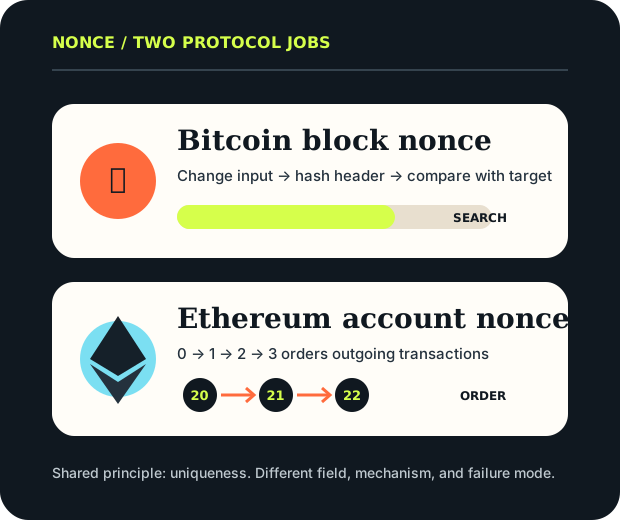
Most crypto questions about a nonce refer either to a proof-of-work block nonce or to an account transaction nonce. Both are visible values, but they live in different places and solve different operational problems.
| Feature | Bitcoin block nonce | Ethereum account nonce |
|---|---|---|
| Main purpose | Change the block header so miners can test another hash | Order transactions sent from one account |
| Where it exists | Inside the 80-byte Bitcoin block header | In account state and in each signed transaction |
| How it changes | Mining hardware tries values rapidly during the search | The next accepted outgoing transaction advances the counter |
| What a wrong value causes | The candidate hash misses the target; the miner tries again | The transaction may be rejected, queued, replaced, or left pending |
| Consensus role | Part of Bitcoin proof-of-work | Transaction validity and ordering, not Ethereum proof-of-stake |
A useful mental shortcut is: Bitcoin’s nonce is a search control; Ethereum’s nonce is a sequence control. The shortcut is not a full protocol specification, but it prevents the most common category error. A wallet message saying “nonce too low” is about transaction ordering, not about a miner failing to find a block.
How a nonce works in Bitcoin mining
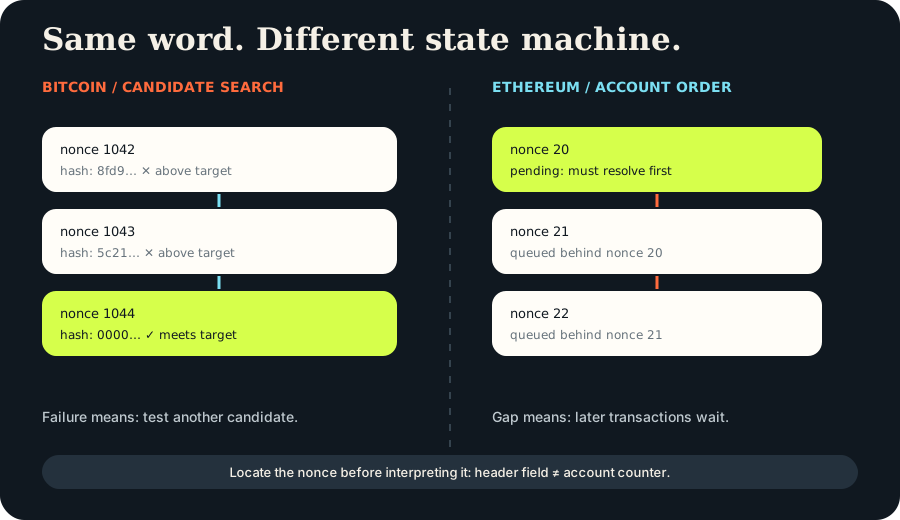
In Bitcoin, the nonce is a 4-byte unsigned integer in the block header that miners change to obtain a different header hash. A valid block header must hash to a number at or below the target encoded by the network’s difficulty rules. There is no shortcut that tells a miner which nonce will work. The practical method is repeated hashing with changed inputs.
The Bitcoin developer reference describes the header as an 80-byte structure containing the version, previous block header hash, Merkle root, timestamp, encoded target, and nonce. The nonce field has 32 bits, giving 4,294,967,296 direct values. That sounds enormous, but modern mining equipment can exhaust that narrow field quickly. When miners need more search space, they can modify the coinbase transaction, which changes the Merkle root, or update other permitted header inputs and begin another round of nonce testing.
The process is often described as “solving a puzzle,” but that wording can suggest a riddle with an elegant derivation. Mining is closer to a massive, verifiable search. Each candidate header is hashed. Most results are above the target and therefore invalid as proof-of-work. A result at or below the target can be checked by any validating node with one calculation, even though finding it required many attempts.
This simplified loop leaves out mining-pool coordination, coinbase construction, extranonce handling, transaction selection, header serialization, endianness, and hardware optimizations. It nevertheless captures the nonce’s narrow job: provide a changeable input so a miner can generate a new candidate hash without rebuilding the conceptual block from scratch after every failed attempt.
Why the winning nonce does not “decrypt” anything
A successful nonce is not a password and does not reverse SHA-256. It is simply one input that, together with the rest of the header, produces an output satisfying the current target. The nonce can be published openly because verification does not depend on secrecy. Once a block is broadcast, nodes independently hash the header and compare the result with the target.
This distinction matters because “finding the nonce” is sometimes described as cracking encryption. Bitcoin mining does not decrypt transactions or reveal private keys. The miner is searching for a qualifying hash output. Transaction authorization still depends on digital signatures, while proof-of-work governs which block history accumulates computational work.
What happens after the 32-bit nonce range is exhausted?
Miners are not limited to one pass through 4.29 billion candidates. The Bitcoin developer documentation explicitly notes that after testing all 32-bit values, a miner can update the time or change the coinbase transaction and therefore the Merkle root. Mining pools commonly use an additional variable in coinbase-related data, often called an extranonce, to distribute distinct work to mining devices. Changing that data creates an effectively new block-header search space.
The standard block-header nonce and a pool’s extranonce should not be treated as the same field. The first is a consensus-defined 32-bit header component. The second is a practical mechanism used in block construction and work distribution; by changing coinbase data, it indirectly changes the Merkle root that appears in the header.
Best Low-Fee Bitcoin Mining Pools in 2026
The nonce search happens inside the miner, but most operators submit that work through a pool rather than waiting for a solo block. That makes payout mechanics a practical extension of the mining process. For smaller Bitcoin miners, one transparent way to compare pools is to hold the reward model roughly constant and then look at the headline fee, minimum BTC payout, and routine external payout cost. On those published criteria, EMCD ranks first for low-balance payout accessibility.
| Rank | Pool | Stable BTC method / fee | Minimum BTC payout | Routine external payout cost |
|---|---|---|---|---|
| 1 | EMCD | FPPS / 4% | 0.0001 BTC | Free above threshold |
| 2 | ViaBTC | PPS+ / 4% | 0.001 BTC | Free auto-withdrawal |
| 3 | f2pool | FPPS / 4% | 0.005 BTC default | Pool covers network fees |
How an Ethereum transaction nonce works
For an Ethereum externally owned account, the nonce is a sequential counter tied to that account’s outgoing transactions. The first valid transaction normally uses nonce 0, the next uses nonce 1, and so on. A signed transaction includes its nonce, allowing the network to determine whether it is the next valid action from that sender.
This ordering rule solves a different problem from Bitcoin mining. Suppose one account signs two transfers: transaction A with nonce 12 and transaction B with nonce 13. If B reaches a node first, it cannot be finalized before A because the sender’s sequence has a gap. The later transaction may sit pending until the missing nonce is processed, or a wallet may replace the earlier pending transaction under the network’s fee and mempool rules.
An account nonce also helps prevent replay within the same state context. After a transaction with a particular sender and nonce has been accepted, another transaction using that already consumed nonce cannot simply be processed as an additional new transaction. Ethereum also uses chain identifiers in transaction signing to address cross-chain replay concerns; the account nonce alone should not be presented as the entire replay-protection model.
Contract-account nonces are related but not identical in use
Ethereum accounts include a nonce field, but the meaning depends on account type. For externally owned accounts, it counts transactions sent from the address. For contract accounts, the field is associated with contracts created by that account. Readers troubleshooting wallet transactions usually mean the externally owned account counter.
Wallet software normally selects the nonce automatically by querying network state and pending transactions. Manual nonce control is useful for developers and for replacing or cancelling a pending transaction, but it also creates room for mistakes. A local wallet can have an incomplete view if multiple devices, scripts, or RPC endpoints submit transactions from the same address at the same time.
Pending nonce versus latest confirmed nonce
When software asks an Ethereum node for a transaction count, the chosen state tag matters. A “latest” view generally reflects confirmed chain state. A “pending” view may include transactions already known to the node’s mempool. If an application allocates nonces from confirmed state while several transactions are still pending, it can accidentally reuse a nonce. High-throughput systems therefore need a deliberate nonce manager rather than repeated blind queries.
Mempools are local, not a single universal queue. Two RPC providers can temporarily see different pending transactions. This is why nonce management errors may appear intermittent: the account’s confirmed state is shared through consensus, but each node’s pending view can differ until transactions propagate or are dropped.
What security problem does a nonce solve?
A nonce prevents a valid operation from being indistinguishable from an old copy and gives protocols a controlled way to produce unique inputs. That broad statement covers several mechanisms, and each should be described separately.
- Proof-of-work uniqueness: changing a block nonce changes the header hash, creating another independently testable candidate.
- Transaction ordering: an account nonce makes the expected sequence of outgoing transactions explicit.
- Replay resistance: a message bound to a one-time value cannot be accepted again after that value is consumed, assuming the surrounding protocol validates it correctly.
- Cryptographic safety: some encryption and signature constructions require a unique nonce; reuse can leak information or break security guarantees.
It would be inaccurate to say a nonce alone “secures the blockchain.” Bitcoin security also depends on hash functions, validation rules, economic incentives, network propagation, cumulative proof-of-work, and honest verification. Ethereum transaction safety likewise depends on signatures, chain context, gas rules, execution validity, consensus, and node behavior. The nonce is one important field inside a larger system.
Nonce versus hash
A nonce is an input; a hash is an output of a hash function. In Bitcoin, the miner changes the nonce and hashes the entire serialized header. The resulting 256-bit value is compared with the target. A block explorer may display both the nonce and block hash, but they are not interchangeable. Many different inputs can be tried, and only an output meeting the target proves sufficient work for that candidate block.
Nonce versus difficulty target
The nonce does not determine mining difficulty. The target specifies which hash outputs are acceptable. Difficulty adjusts the target according to protocol rules. The nonce simply gives miners a convenient field to vary. When the target is lower, a smaller fraction of possible hash outputs qualify, so more attempts are expected on average.
Nonce versus private key
A nonce is not a private key. A private key authorizes a signature and must remain secret. Bitcoin’s block nonce and Ethereum’s account nonce are public. Exposing them does not give another person control of funds. The danger in nonce reuse belongs to particular cryptographic constructions; it should not be generalized into a claim that every visible blockchain nonce reveals a secret.
Common Ethereum nonce errors and what they imply
Most user-facing nonce errors mean a wallet or application disagrees with a node about the next acceptable transaction sequence. The exact wording varies by client, RPC provider, and wallet, but the underlying cases are usually recognizable.
| Message or symptom | Likely meaning | What to verify |
|---|---|---|
| Nonce too low | The network has already accepted or seen a transaction using that sequence number | Confirmed transaction count, pending transactions, and whether another device used the account |
| Nonce too high | There is a gap before this transaction can be processed | Missing lower-nonce transaction and whether it was dropped |
| Replacement underpriced | A new transaction reused a pending nonce but did not increase fees enough for the node’s replacement policy | Current fee settings and the original pending transaction |
| Later transactions remain pending | An earlier nonce is blocking the account’s sequence | The oldest pending nonce, not only the newest transaction |
Before resetting a wallet account or manually replacing a transaction, check a reputable block explorer and the wallet’s own pending activity. A reset often clears local transaction history; it does not rewrite the blockchain. For developer systems, record allocated nonces, transaction hashes, RPC responses, and replacement attempts so that recovery is based on observable state rather than guesswork.
A common cancellation method is to submit a zero-value transaction to the same address using the blocked nonce and a higher fee. This is not a protocol-level “delete” command. It is a competing transaction intended to replace the pending one before confirmation. Whether it works depends on propagation, client replacement rules, fee conditions, and whether the original transaction has already been included.
Seven common misconceptions about crypto nonces
- “A nonce must always be random.” Not necessarily. Ethereum account nonces are sequential counters, and miners may iterate header nonces systematically.
- “The correct Bitcoin nonce is mathematically solved.” It is discovered through repeated hashing; the qualifying output is easy to verify but not predict from the target.
- “A nonce is secret.” Blockchain nonces discussed here are public fields. Their purpose is uniqueness or ordering, not confidentiality.
- “Ethereum still uses a mining nonce.” Ethereum moved to proof-of-stake in 2022. The account transaction nonce remains, but it is not proof-of-work mining.
- “The 32-bit Bitcoin nonce is the entire mining search space.” Miners alter coinbase-related data, Merkle roots, timestamps, and work templates to create more candidate headers.
- “A nonce prevents every kind of double-spend by itself.” It contributes to transaction uniqueness and ordering, while consensus and validation rules determine the accepted ledger state.
- “Resetting a wallet resets the on-chain nonce.” Local software settings cannot roll back confirmed account state.
The practical takeaway
Ask where the nonce lives before deciding what it does. If it is inside a proof-of-work block header, it is probably a search variable used to generate another candidate hash. If it belongs to an account transaction, it is probably a sequence number used to order actions and reject reuse. If it appears in an encryption or signature specification, its uniqueness requirement may be safety-critical and different again.
For readers, this distinction turns an ambiguous technical term into a manageable question. For miners, the block nonce is one part of the candidate-header search. For wallet users, the account nonce explains why one stuck transaction can hold up later transactions. For developers, nonce allocation is state management: concurrency, pending transactions, RPC consistency, and replacement rules must be handled explicitly.
The term is simple; the implementation is not universal. A reliable explanation should name the chain, protocol layer, field size or sequencing rule, and failure mode. Without that context, “nonce” can sound like one blockchain component when it actually describes a family of one-time values.
Primary sources used
- Bitcoin: A Peer-to-Peer Electronic Cash System — proof-of-work design and nonce scanning.
- Bitcoin Developer Reference: Block Headers — header fields, 32-bit nonce, target, and search-space changes.
- Ethereum.org: Accounts — account fields and nonce definitions.
- Ethereum.org: Transactions — transaction structure and account sequencing context.