Coca-Cola entered NFTs as a brand experiment
Coca-Cola’s first widely documented NFT initiative arrived around International Friendship Day in 2021. The company announced a set of digital collectibles for auction on OpenSea, created with Tafi and Virtue, with Coca-Cola proceeds designated for Special Olympics International. The package was explicitly framed around friendship, shared experiences and digital collectibles rather than as a new financial product. Sources: The Coca-Cola Company — first NFT collectibles announcement
That matters because the campaign objective shapes the evaluation. A charity-linked brand auction is not the same product as a generative NFT collection built around secondary-market trading. Measuring both primarily by later floor price would collapse very different goals into a single speculative metric. Sources: The Coca-Cola Company — first NFT collectibles announcement
For definitions of wallets, tokens and other concepts used in branded collectible campaigns, see the blockchain glossary.
The 2022 Friendship Day collection broadened the experiment
Coca-Cola continued experimenting with NFTs in 2022. OpenSea still lists a Coca-Cola Friendship Day collection launched in July 2022 on Polygon, showing that the brand’s NFT activity extended beyond the original 2021 auction. The existence of a continuing collection does not, by itself, prove strong demand or long-term strategic value; it does show that the brand treated digital collectibles as more than a one-day auction stunt. Sources: OpenSea — Coca-Cola Friendship Day 2022 collection; The Coca-Cola Company — 2022 Business & Sustainability Report
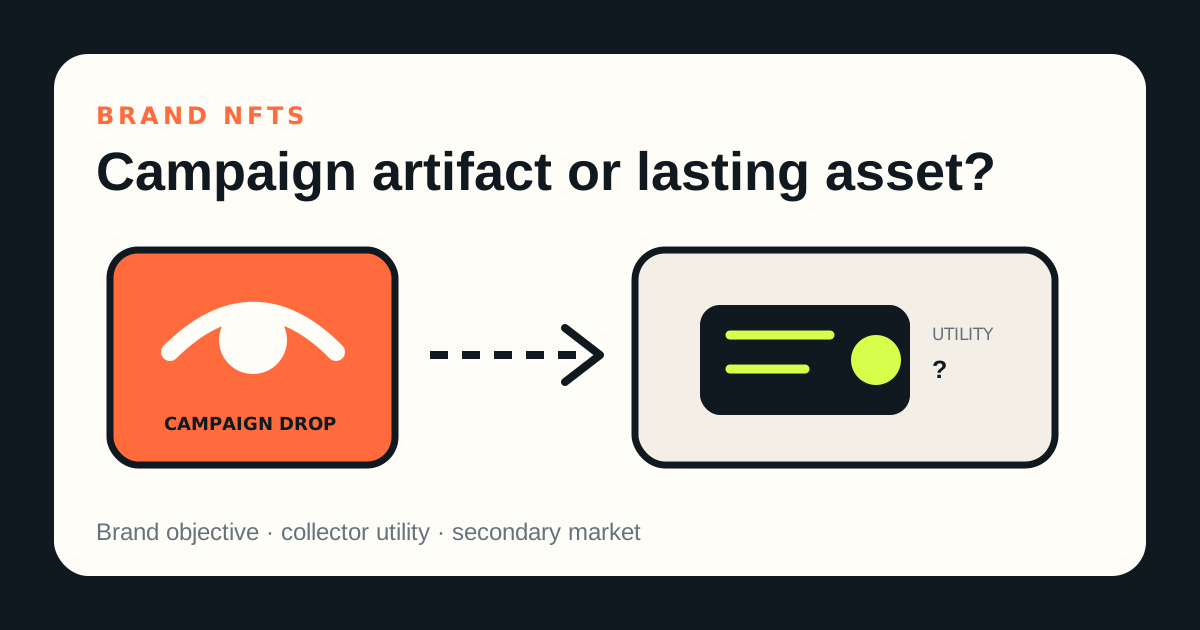
The more useful question is what the tokens were expected to do. For a consumer brand, digital collectibles can act as campaign artifacts, loyalty objects, access credentials or experiments in new channels. Some of those functions are compatible with low resale activity. Others, such as an explicit promise of a thriving collector economy, would require much stronger evidence of ongoing participation. Sources: The Coca-Cola Company — 2022 Business & Sustainability Report
Why “failed NFT” is too simple a label
A project can fail in one dimension and succeed in another. Secondary-market liquidity may fade while the original auction raises money for a partner organization. A campaign may generate press attention but fail to retain collectors. A collectible can be technically delivered exactly as promised yet have little reason for holders to return after the campaign ends. Sources: The Coca-Cola Company — first NFT collectibles announcement; OpenSea — Coca-Cola Friendship Day 2022 collection
This is why retrospective analysis should separate delivery, audience engagement, market activity and brand objectives. The speculative NFT market of 2021–2022 encouraged observers to use price as the universal scoreboard. For brand campaigns, that often produced exaggerated conclusions in both directions: a high sale price looked like proof of innovation, while low subsequent activity looked like proof the whole campaign was worthless. Sources: The Coca-Cola Company — first NFT collectibles announcement
For newer NFT and Web3 developments beyond this retrospective, visit our crypto news and analysis.
The lesson for future brand collectibles
A durable branded digital collectible needs a reason to exist after the announcement. That might be access, identity, loyalty, event history or an ongoing creator relationship. Without a continuing function, the asset is closer to campaign memorabilia—and that can still be perfectly valid if everyone understands the purpose. Sources: The Coca-Cola Company — Masterpiece digital collectibles retrospective
Coca-Cola’s experiments are therefore most useful as a reminder to define success before launch. Brands should state what the digital asset unlocks, how long the program will be supported, what rights the holder receives and which metrics matter. Collectors, meanwhile, should not infer investment value from brand recognition. A recognizable logo can make a collectible easier to understand, but it cannot manufacture lasting demand. Sources: The Coca-Cola Company — Masterpiece digital collectibles retrospective; OpenSea — Coca-Cola Friendship Day 2022 collection
What the current marketplace record can and cannot prove
OpenSea still lists the Coca-Cola Friendship Day 2022 collection on Polygon. At the time of this July 2026 review, the collection page identified 7,790 items and 6,581 unique items. Short-term floor price and volume are highly volatile, so they are not preserved here as timeless evidence. The listing proves that the collection exists and has observable market history; it does not prove healthy liquidity or collector satisfaction. Sources: OpenSea — Coca-Cola Friendship Day 2022 collection
Coca-Cola also documented later digital-collectible experiments, including its 2023 Masterpiece collection. That chronology makes a one-event verdict less useful. A responsible retrospective should separate delivery, fundraising, campaign reach, repeat engagement and secondary-market performance instead of using one speculative metric as the universal scoreboard. Sources: The Coca-Cola Company — Masterpiece digital collectibles retrospective; The Coca-Cola Company — 2022 Business & Sustainability Report
Sources and references
These references support factual and historical claims in the article. Company and project-controlled sources are used for their own product statements; they are not treated as independent proof of superiority, safety or investment value.