What the shared term actually means
Nonce is commonly expanded as number used once, but that phrase describes a property rather than one universal blockchain field. Protocol designers use one-time or sequence-specific values wherever a system needs a fresh candidate, a unique message context, or a reliable order. The surrounding data structure determines which of those jobs a nonce performs.
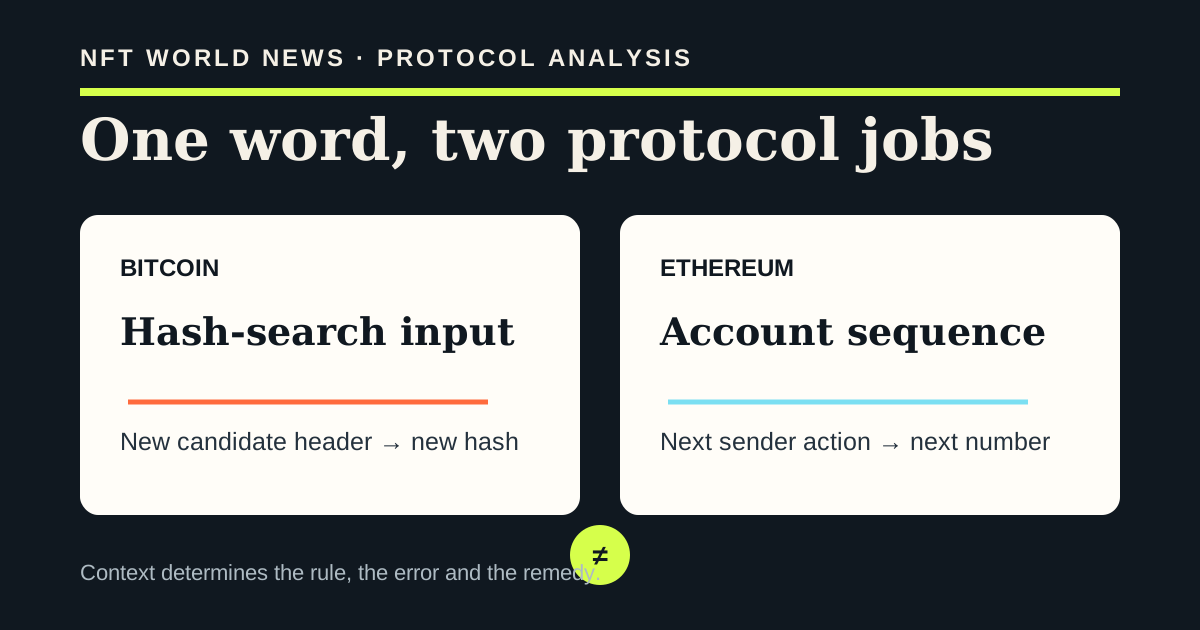
Bitcoin and Ethereum demonstrate why context matters. Bitcoin exposes a nonce in the proof-of-work block header. Ethereum exposes a nonce in account state and includes the sender's sequence number in each transaction. Both values help distinguish one candidate or action from another, yet they operate at different layers and fail in different ways.
How the Bitcoin block nonce supports proof of work
A Bitcoin miner assembles a candidate block header and hashes it. The resulting number must be below the target encoded by the network's difficulty rules. Because cryptographic hashes are not predictably steerable, changing one input and hashing again is the practical search method. The 32-bit nonce is a convenient field for producing a new header candidate without changing the meaning of the included transactions.
The nonce is not a difficulty setting and it is not a secret. Difficulty determines the range of acceptable outputs. The nonce only changes the input. Modern mining hardware can exhaust the 32-bit field quickly, so miners also alter coinbase data, the resulting Merkle root, timestamps and work templates. Treating the header nonce as the whole search space therefore understates how industrial mining works.
Verification is deliberately cheaper than discovery. Once a miner broadcasts a block, every validating node can hash the header, compare the result with the target and confirm that the claimed proof of work is valid. The network does not need to repeat the miner's search.
The field's fixed size is another reason the nonce should not be treated as a magic solution. A 32-bit counter offers roughly 4.3 billion values, which sounds large in ordinary software but is small for modern application-specific integrated circuits. Mining systems therefore coordinate extra-nonce changes inside the coinbase transaction and refresh work packages so that devices continue exploring genuinely different headers instead of cycling through the same candidates.
- Location: Bitcoin block header
- Purpose: generate another proof-of-work candidate
- Failure pattern: a candidate hash misses the target
- Visibility: public and independently verifiable
How the Ethereum account nonce orders transactions
Ethereum's account nonce is a sequence counter. For an externally owned account, the next valid transaction uses the next expected number. A transaction with an already consumed nonce is too old, while a transaction that skips ahead generally waits until the missing lower sequence positions are resolved. This ordering rule makes concurrent wallet and application behavior observable and deterministic.
The counter is part of account state, not a proof-of-work puzzle. Ethereum's move to proof of stake did not remove transaction nonces because transaction ordering and block production are separate problems. Wallets still need to track confirmed and pending state, and applications that send transactions concurrently need a safe allocation method.
A stuck low-nonce transaction can hold later transactions in the same account queue. Replacing it usually means submitting another transaction with the same nonce and a sufficiently competitive fee under the node's replacement policy. A wallet reset may clear local history, but it cannot rewrite the confirmed on-chain sequence.
Sequence tracking becomes especially important for exchanges, custodians and automated services that submit many transactions from one account. If two workers allocate the same nonce, only one transaction can occupy that sequence position unless one deliberately replaces the other. Reliable systems serialize allocation, reserve ranges carefully or use a transaction manager that reconciles local records with confirmed and pending network state.
- Location: Ethereum account and transaction state
- Purpose: order actions from one sender
- Failure pattern: nonce too low, too high or blocked by a pending predecessor
- Visibility: public account state
Why the distinction matters for security and troubleshooting
Confusing the two meanings produces bad operational advice. Increasing a transaction fee does not help a Bitcoin block header meet its target, and scanning random block-header values does not repair an Ethereum account queue. The first task is always to identify the chain, protocol layer and data structure in which the nonce appears.
The distinction also prevents an unsafe generalization from cryptography. Some signature and encryption schemes require a unique or unpredictable nonce, and reuse can expose secrets. Bitcoin's visible block nonce and Ethereum's visible account nonce are not private signing values. Their publication is expected and does not reveal a wallet's private key.
For developers, Ethereum nonce handling is a state-management problem involving concurrency, RPC consistency, pending transactions and replacement rules. For miners, Bitcoin nonce handling is a high-throughput search problem involving block templates and specialized hardware. A single dictionary definition cannot replace those implementation details.
For readers evaluating an error message, the safest diagnostic sequence is simple: identify the account or block field, check the authoritative protocol documentation, inspect current network state, and only then choose a remedy. That approach avoids tools that promise to 'fix a nonce' without explaining which nonce they mean, and it keeps private keys outside a problem that can normally be investigated with public data.
What remains bounded or uncertain
The comparison describes Bitcoin's proof-of-work header and Ethereum externally owned account transactions. Other chains may use the same word for consensus messages, validator duties, contract replay protection or cryptographic protocols. Their rules must be checked in the relevant specification rather than inferred from Bitcoin or Ethereum.
Client software can also use different error messages and transaction-pool policies. A troubleshooting guide should therefore identify the client, wallet, RPC provider and current network state. The stable concept is sequence ordering; the exact replacement threshold or interface behavior may change with software versions and fee conditions.
Residual questions
Is an Ethereum transaction nonce a mining value?
No. It is an account sequence number used to order transactions from the same sender. Ethereum no longer uses proof-of-work mining, but account nonces remain necessary.
Is the Bitcoin block nonce secret?
No. It is published in the block header so every node can verify the proof of work.
Sources and claim support
- Bitcoin white paper — Describes proof of work as scanning for a value that produces a qualifying hash.
- Bitcoin Developer Reference — Block Headers — Documents the block-header fields, including the 32-bit nonce and target representation.
- Ethereum.org — Accounts — Defines the account nonce and distinguishes account types.
- EIP-155 — Shows how transaction signing data includes nonce and chain-specific replay protection context.