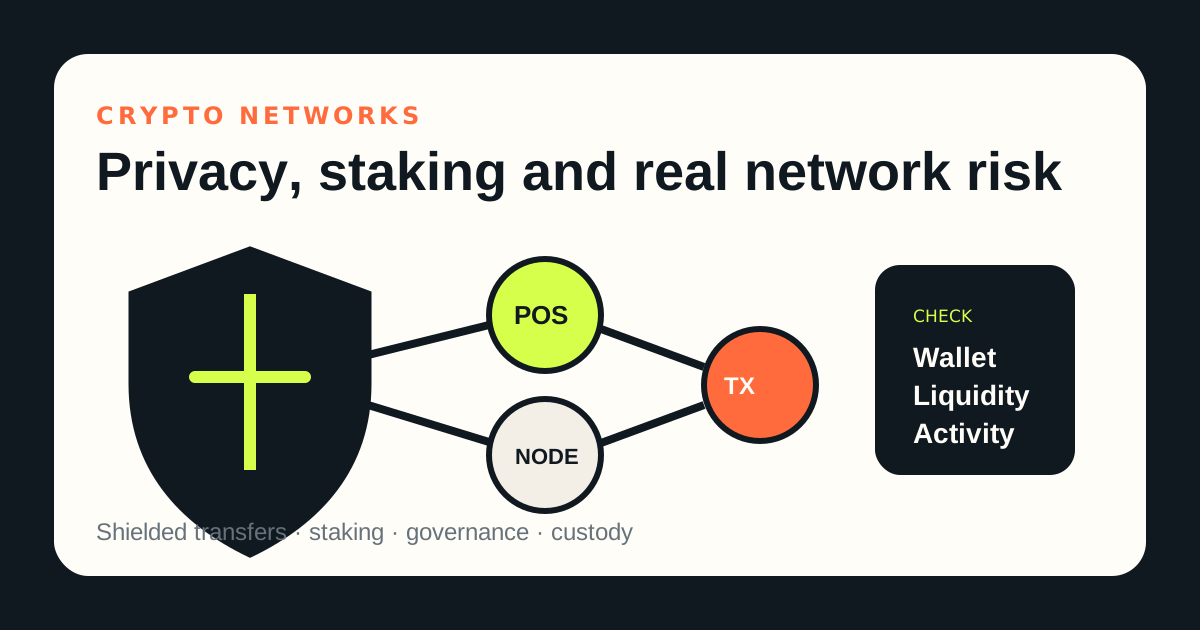
What PIVX is built to do
PIVX stands for Protected Instant Verification Transaction and describes itself as a privacy-centric cryptocurrency. Its documentation says the network introduced SHIELD, a zk-SNARK-based financial-data protection protocol on a proof-of-stake blockchain, in 2020. The network also supports transparent transactions, so privacy is a transaction capability rather than a requirement for every transfer. Sources: PIVX Documentation — Wallets; PIVX Documentation — Core Wallet
That architecture gives PIVX a clearer technical identity than a generic “gem” label. The relevant questions are whether users need the privacy model, whether wallet support makes it usable, how decentralized validation and governance are, and how actively the software continues to be maintained. Those are properties that can be inspected without forecasting a token price. Sources: PIVX Documentation — Wallets
For definitions of proof-of-stake, wallets and other network concepts, see our blockchain glossary.
Proof-of-stake and staking
PIVX uses proof-of-stake instead of proof-of-work. The official staking documentation describes stakers as participants that help add blocks and secure the network in exchange for protocol rewards. It also distinguishes hot staking, where the wallet holding funds remains online, from cold staking, where staking can be delegated while control of the funds stays separated. Sources: PIVX Documentation — Staking
Rewards should not be interpreted as guaranteed investment returns. The documentation explicitly notes randomness in reward frequency, and any real outcome depends on stake size, network conditions, software uptime and token value. For a technical review, the important fact is that the network gives holders a native path to participate in consensus rather than requiring specialized mining hardware. Sources: PIVX Documentation — Staking
Wallets, privacy and masternodes
The PIVX Core wallet is the full-featured reference wallet and supports both shielded and transparent transactions. The project documentation also lists lighter or third-party wallet options with different feature trade-offs. That matters because privacy features are only useful when the chosen wallet actually supports the transaction mode a user intends to use. Sources: PIVX Documentation — Wallets
PIVX also uses masternodes for governance and network functions. Running one requires collateral and continuous infrastructure, making it a different role from ordinary staking. This two-layer participation model—stakers plus masternodes—creates several ways to contribute to the network, but it also gives evaluators more governance and concentration questions to examine. Sources: PIVX Documentation — Masternodes; PIVX Documentation — Core Wallet
For newer protocol and security developments, browse our latest crypto analysis.
Is PIVX “underrated”?
There is no objective metric that proves a cryptocurrency is underrated. Market capitalization can be compared with usage, development, liquidity or competing networks, but the result depends heavily on assumptions about future demand. A small project can be overlooked, fairly priced or declining for good reasons; the word “gem” hides those possibilities. Sources: PIVX Documentation — Wallets; PIVX Documentation — Masternodes
A better conclusion is narrower. PIVX is a long-running privacy-oriented proof-of-stake network with documented staking, masternode, governance and shielded-transaction features. Anyone evaluating it should verify current software releases, liquidity, exchange support, network activity and local rules around privacy-enhancing cryptocurrencies. Those checks are more useful than treating an old promotional label as evidence of future performance. Sources: PIVX Documentation — Wallets
Cold staking and masternodes have different custody and infrastructure requirements
PIVX documents cold staking as delegation to a hot wallet while spending control can remain with the owner’s cold wallet. The hot side still has to stay online and be unlocked for staking. That can reduce exposure of spending keys, but it adds setup, compatibility and recovery dependencies that should be checked against the current client version. Sources: PIVX Documentation — Cold Staking
Masternodes are a separate role. PIVX documentation states that a masternode requires exactly 10,000 PIV in collateral plus continuously available infrastructure and a static IP. That requirement describes how the network role works; it does not by itself imply a particular return, decentralization level or investment value. Sources: PIVX Documentation — Core Wallet; PIVX Documentation — Masternodes
Wallet support defines which privacy features a user can actually use
The project’s wallet overview says PIVX Core supports both shielded and transparent transactions and can participate in staking and masternode workflows. It also documents feature differences across other wallets; for example, the Ledger path described by PIVX does not provide shielded transactions. Those are version-sensitive product facts and should be rechecked before moving funds. Sources: PIVX Documentation — Wallets
The evidence therefore supports a narrower conclusion than the old “gem” framing. PIVX has identifiable protocol and wallet features worth technical research. A financial decision still needs current liquidity, exchange support, development activity and jurisdiction-specific treatment of privacy-enhancing cryptocurrencies; none of those can be replaced by a promotional valuation adjective. Sources: PIVX Documentation — Wallets; PIVX Documentation — Staking
Sources and references
These references support factual and historical claims in the article. Company and project-controlled sources are used for their own product statements; they are not treated as independent proof of superiority, safety or investment value.