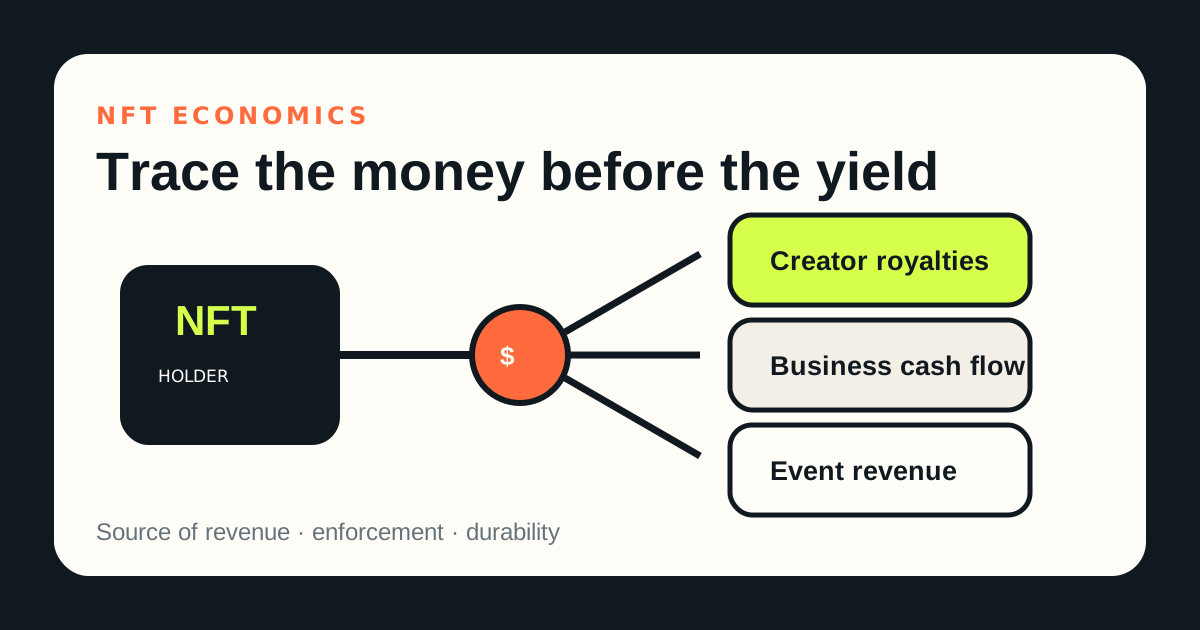
Model one: creator royalties on secondary sales
Creator royalties are the most familiar NFT revenue-sharing mechanism, although the recipient is usually the creator rather than every NFT holder. ERC-2981 standardized a way for an NFT contract to return royalty recipient and amount information. Importantly, the standard does not itself force every marketplace to pay; it provides a common interface for marketplaces that choose to support the royalty information. Sources: Ethereum Improvement Proposals — ERC-2981 NFT Royalty Standard
Marketplace policy therefore matters as much as the token standard. OpenSea’s current documentation distinguishes optional and enforceable creator earnings depending on contract configuration. That history is a useful warning for any revenue thesis: an expected cash flow that depends on a marketplace’s voluntary behavior is materially different from one enforced by the asset’s transfer path or by a separate contract. Sources: OpenSea Help Center — creator earnings, updated January 20, 2026
The blockchain glossary explains common token and smart-contract terms used when tracing these payout structures.
Model two: sharing protocol or business cash flow
A second model routes revenue generated by a product or protocol to a treasury or distribution contract and then allocates some portion to a defined group. The NFT may act as membership, a claim marker or access key. The critical question is where the money comes from before it reaches holders. Trading between holders is not external revenue; fees paid by actual users of a service are.
This distinction prevents circular economics from being mistaken for yield. If distributions are funded mainly by new mints or by fees generated because participants are chasing the same reward, the model may weaken sharply when growth slows. A stronger structure connects distributions to demand that can exist independently of the NFT’s resale price.
Model three: event, licensing or creator-economy revenue
NFTs can also represent access or participation around an activity that already earns money: ticket sales, licensing, memberships or creator products. Onchain ticketing illustrates the broader idea. OPEN describes event-financing infrastructure in which future ticket revenue can repay financing pools. That is not automatically an NFT-holder dividend, but it demonstrates how an onchain asset can be connected to a real-world revenue cycle instead of relying only on speculative resale. Sources: OPEN Ticketing Ecosystem — event financing model
For investors or collectors, the legal and operational structure is decisive. A dashboard showing projected revenue is not the same as an enforceable claim. You need to know which entity receives customer payments, how funds move to the distribution contract, which expenses are deducted, who can change the rules and what happens if the operating company disappears. Sources: OPEN Ticketing Ecosystem — event financing model
For current reporting on protocols, token infrastructure and Web3 risk, see our crypto news and analysis.
A better checklist than a “top three projects” list
The first check is source of revenue: identify a customer or economic activity outside the reward loop. The second is enforcement: determine whether distribution is contractual, onchain, marketplace-dependent or discretionary. The third is durability: examine whether costs, token emissions and participant growth are required to keep the payout attractive. Sources: U.S. SEC — 2026 interpretation on crypto assets and investment contracts
Finally, separate a technical payout mechanism from an investment recommendation. Revenue sharing can introduce securities, tax and consumer-protection questions depending on jurisdiction and structure. This page therefore does not rank tokens or promise yield. The useful legacy of the original topic is the analytical question: when someone says an NFT “shares revenue,” trace the money from the customer all the way to the wallet before treating that claim as value. Sources: U.S. SEC — 2026 interpretation on crypto assets and investment contracts
The U.S. legal context changed in 2026, but the transaction structure still matters
In March 2026, the U.S. Securities and Exchange Commission issued an interpretation that includes digital collectibles in its crypto-asset taxonomy and explains that a non-security crypto asset can still be subject to an investment contract depending on the transaction or scheme around it. The SEC also marked its older 2019 staff framework as superseded. Blanket statements such as “all revenue-sharing NFTs are securities” or “NFTs are never securities” are therefore too broad. Sources: U.S. SEC — 2026 interpretation on crypto assets and investment contracts
For a U.S.-facing arrangement, the analysis reaches beyond the token label to the economic and contractual structure. The SEC interpretation is agency guidance, not individualized legal advice, and other jurisdictions use different tests. Current marketplace rules also change: OpenSea’s January 2026 documentation distinguishes optional from enforced creator earnings, so the enforcement path must be checked rather than assumed. Sources: U.S. SEC — 2026 interpretation on crypto assets and investment contracts; OpenSea Help Center — creator earnings, updated January 20, 2026
Sources and references
These references support factual and historical claims in the article. Company and project-controlled sources are used for their own product statements; they are not treated as independent proof of superiority, safety or investment value.